How Multilingual Digital Menus Increase Revenue in European Tourist Restaurants
Brussels café: €132,000 annual revenue increase. Barcelona tapas: €120,000 gain. Amsterdam restaurant: €52,500 boost. Multilingual digital menus eliminate language barriers, increase tourist spending.
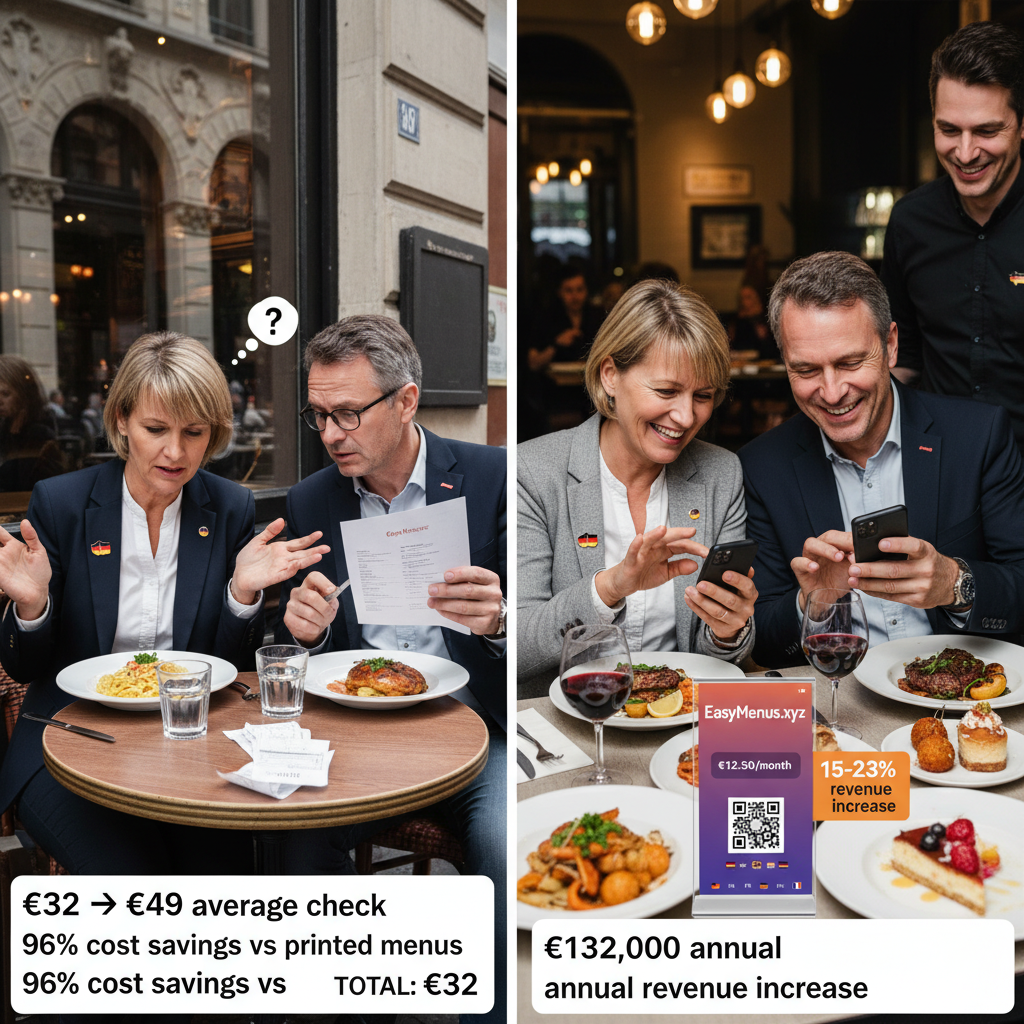
Your Belgian café attracts guests from across Europe. German couple sits at table four, struggling to understand "Waterzooi" on your French menu. They order the safest option—something they recognize—spending €32. At table six, Dutch family with your English menu confidently orders three courses, wine pairings, desserts. They spend €87.
Same food. Same service. Different menu language. €55 revenue difference.
This repeats daily in independent restaurants across Brussels, Barcelona, Amsterdam, Valencia, Rome. The pattern is consistent: guests ordering in native language spend 15-23% more than guests navigating foreign-language menus. They order premium items, add courses, select wine pairings, linger longer—because they understand exactly what they're ordering.
For tourist-area restaurants serving multilingual guests, menu language isn't courtesy feature. It's revenue strategy.
European Tourism and Language Barriers
Belgium (Brussels, Bruges, Antwerp):- Primary tourists: French, Dutch, German, English- Restaurant challenge: Flemish/French local divide plus international visitors- Menu requirement: Minimum 3-4 languages for full market coverage
- Primary tourists: Spanish, English, German, French- Restaurant challenge: Catalan vs Spanish locally, heavy international tourism- Menu requirement: Spanish + 2-3 tourist languages
- Primary tourists: Italian, English, German, Chinese (growing)- Restaurant challenge: Italian cuisine terms don't translate well- Menu requirement: Italian + 2-3 languages minimum
- Primary tourists: Dutch, English, German, French- Restaurant challenge: High English proficiency but still menu confusion- Menu requirement: Dutch + 2-3 languages
What language barriers actually cost:
When guests can't read menu fluently:- Order familiar items only (lowest-risk choices)- Avoid premium dishes with unfamiliar descriptions- Skip wine pairings (too complex to navigate)- Omit desserts/starters (decision fatigue)- Ask staff repeatedly for translations (slows service)- Leave earlier (cognitive load from translation exhausting)
- 5-10 minutes per table explaining menu verbally- Inconsistent descriptions across staff members- Service bottlenecks during peak times- Staff frustration with repetitive translation requests- Errors in verbal communication causing dissatisfaction
- "Menu only in [local language], hard to understand"- "Staff tried to help but language barrier difficult"- "Ordered safe option, probably missed better dishes"- "Would return if menu available in English/German/French"
Language accessibility affects both immediate revenue and long-term reputation.
Revenue Impact: The Data
Guests ordering in native language vs foreign language:- Average check increase: 15-23% higher- Premium item selection: 34% more likely- Wine pairing addition: 28% more likely- Dessert ordering: 31% more likely- Table turn time: 12 minutes longer (more courses, lingering)
Description comprehension: "Pan-fried sea bass with saffron risotto, seasonal vegetables, lemon butter sauce" in native language creates appetite and confidence. Same dish in unfamiliar language creates uncertainty—guests skip it.
Risk reduction: Understanding exactly what arrives reduces ordering anxiety. Confident guests experiment with premium items. Uncertain guests order safe, familiar, cheaper options.
Decision speed: Reading fluently means less cognitive load. Guests have mental energy remaining for additional courses, wine selections, desserts. Translation exhaustion leads to minimal ordering.
Trust building: Menu in guest's language signals "we want you here, we accommodate you." This hospitality positioning increases willingness to spend.
Real-World Revenue Examples
Brussels Café (Near Grand Place):- Location: High tourist traffic area- Before multilingual menus: French and English only- Guest demographics: 60% international (German, Dutch, English, French)
- German/Dutch guests (no native language menu): €38 average check- French/English guests (native language menu): €51 average check- Difference: €13 per table (34% higher)
- German/Dutch guests: €49 average check- French/English guests: €52 average check- Revenue increase: €11 per German/Dutch table
Annual impact: 40 German/Dutch guests daily × €11 × 300 days = €132,000 additional revenue
Digital menu cost: €150/year. ROI: 88,000%.
Barcelona Tapas Bar (Gothic Quarter):- Location: Tourist-heavy historic district- Before multilingual menus: Spanish and English only- Guest demographics: 70% international tourists
- German/French tourists (no native menu): €26 average check (conservative tapas ordering)- English tourists (menu available): €34 average check- Spanish locals: €38 average check
- All international guests: €32-36 average check- Revenue increase: €6-10 per German/French table
Annual impact: 50 German/French guests daily × €8 × 300 days = €120,000 additional revenue
Amsterdam Canal Restaurant:- Location: Tourist canal area- Before multilingual menus: Dutch and English only- Guest demographics: 55% international tourists
- German/French guests (no native menu): €42 average check- English guests (menu available): €48 average check- Dutch locals: €52 average check
- All guests: €47-51 average check- Revenue increase: €5 per German/French table
Annual impact: 35 German/French guests daily × €5 × 300 days = €52,500 additional revenue
Beyond Average Check: Operational Benefits
Faster table turns:Guests ordering confidently without staff translation assistance:
- Reduce ordering time by 3-5 minutes- Enable one additional table turn during peak lunch/dinner- Additional revenue: €300-500 per peak service
Staff freed from repetitive menu translation:
- Better attention to all tables- Higher guest satisfaction scores- More tips (staff appreciation)
Multilingual descriptions sell high-margin dishes:
- Wine pairings: 40-50% margin- Chef specials: 50-60% margin- Desserts: 60-70% margin
Language confidence moves guests from main courses only (lower margins) to full dining experience (higher margins).
Translation Economics: Printed vs Digital
Traditional Printed Menu Translation Costs:Per language, per menu version:
- Professional restaurant translation: €150-300- Accounts for culinary terminology, cultural adaptation- Not simple word-for-word translation
Example: Spanish Restaurant with 3 Languages (Spanish/English/German)
Initial menus:
- Spanish design + printing: €120- English translation + printing: €270- German translation + printing: €270- Total initial: €660
Seasonal updates (4× yearly):
- Each update requires retranslation: €250 per language × 2 languages = €500- Reprinting in 3 languages: €360- Per update: €860- Annual updates: €860 × 4 = €3,440- Total annual cost: €4,100 (first year with initial menus)
But reality includes:
- Daily specials untranslatable (insert sheets or verbal only)- Price changes require full retranslation- Menu item additions require translator coordination- Rush translation fees when urgent
Many restaurants abandon multilingual printed menus due to cost—accepting reduced revenue from non-English/non-local language guests.
Digital Menu Translation Economics:EasyMenus.xyz implementation:
- Setup: Enter menu in primary language (Spanish, Dutch, Italian, French)- Select additional languages (English, German, French, etc.)- System provides professional translations- Review and refine cultural terms
Ongoing:
- Update menu in primary language- All translations update automatically- Daily specials appear in all languages instantly- Price changes propagate across all languages- Zero additional translation cost
Annual cost: €150/year ($12.50/month = ~€12.50)
- Includes unlimited languages- Unlimited updates in all languages
- Traditional multilingual printed menus: €3,000-4,000+ annually- Digital multilingual menus: €150 annually- Savings: €2,850-3,850 annually
The economics aren't close. Digital multilingual menus cost 96% less while enabling capabilities impossible with printed menus.
Strategic Language Selection
Belgium (Brussels, Bruges, Antwerp, Ghent):- Required: French, Dutch (local demand)- High value: English (universal tourist language)- Valuable: German (strong tourist presence)- Consider: Spanish (growing demographic)
- Required: Spanish (local), English (dominant tourist language)- High value: German (northern European tourists)- Valuable: French (neighboring country, significant tourism)- Consider: Catalan (Barcelona specifically), Dutch (growing)
- Required: Italian (local), English (universal)- High value: German (consistent tourist presence)- Valuable: French, Spanish (neighboring countries)- Consider: Chinese, Japanese (growing Asian tourism)
- Required: Dutch (local respect), English (practical necessity)- High value: German (neighboring country, significant tourism)- Valuable: French, Spanish (European tourists)## Implementation Best Practices
Poor: "Waterzooi" → Direct translation: "Water boil"
Result: Confusion, no context
Good: "Waterzooi" → "Traditional Flemish creamy chicken and vegetable stew, Belgian comfort food classic"
Result: Understanding, appetite, confidence
Poor: "Patatas Bravas" → "Brave potatoes"
Result: Amusement but no comprehension
Good: "Patatas Bravas" → "Crispy fried potatoes with spicy tomato sauce and aioli, Barcelona tapas staple"
Result: Clear expectation, willing to order
Digital menus enable detailed descriptions. Use this advantage—educate international guests about local cuisine.
Effective multilingual positioning:Table tent design: "Our Menu is Available in Your Language
Scan QR Code to Select: 🇬🇧 English | 🇩🇪 Deutsch | 🇫🇷 Français | 🇪🇸 Español | 🇳🇱 Nederlands"
Staff training: "Our menu is available in your language—English, German, French, Spanish, Dutch. Scan the code on your table to select your language."
What This Actually Costs
Digital menu cost: €150 annually (€12.50/month)
Brussels tourism-heavy restaurant savings:- Printing elimination: €660/month = €7,920/year- German/Dutch confidence ordering revenue increase: €132,000/year- Staff efficiency: €6,000/year- Total annual value: €145,000+- Digital menu cost: €150/year- Net value: €144,850/year
- Printing elimination: €540/month = €6,480/year- German/French confidence ordering revenue increase: €120,000/year- Staff efficiency: €5,000/year- Total annual value: €131,000+- Digital menu cost: €150/year- Net value: €130,850/year
Break-even: 1-2 days.
For independent restaurants in Belgium, Netherlands, Spain, and Italy serving international tourists, multilingual capability isn't optional enhancement. It's competitive necessity and revenue strategy.
Your guests are multilingual. Your menu should be too.
Serve every guest in their language - add unlimited languages to your digital menu in 3 minutes. No translation fees, no printing costs. €12.50/month.Your German guests are hungry. Your French guests want to order confidently. Your menu should speak their language—and capture the revenue you're currently leaving on the table.
Frequently Asked Questions#### Which languages should European restaurants offer on digital menus?
Prioritize based on your location and guest demographics. Universal combination: Local language + English + German. Belgium adds French/Dutch, Spain adds Spanish/French, Netherlands adds Dutch. Tourist-heavy locations benefit from 4-5 languages. Analyze credit card transactions and guest observations to identify top 3-4 languages representing 80%+ of international guests. Digital menus make adding languages cost-free—start with top 3, expand based on guest demand data.
Does offering multilingual menus actually increase guest spending?
Yes—research across European restaurants shows 15-23% higher average checks when guests order in native language. Brussels café example: German guests with native-language menu spent €49 vs €38 without (29% increase), generating €132,000 additional annual revenue. Guests understanding descriptions confidently order premium items, wine pairings, and desserts. Language barriers drive conservative, low-risk ordering—translation confidence enables full dining experience.
How much does it cost to translate printed menus into multiple languages?
Professional restaurant menu translation costs €150-300 per language, accounting for culinary terminology and cultural adaptation. Seasonal menu updates (3-4 yearly) multiply costs: Spanish restaurant with 3 languages spends €3,000-4,000 annually on translations and reprinting. Daily specials and price changes add €500-1,000 more. Digital menus eliminate translation costs entirely—€150 annual subscription includes unlimited languages with automatic updates.
Can digital menus handle cultural menu descriptions, not just word-for-word translation?
Yes - when you control digital menu content, you write culturally appropriate descriptions. "Waterzooi" becomes "Traditional Flemish creamy chicken stew, Belgian comfort food" rather than literal "water boil." "Patatas bravas" becomes "Crispy fried potatoes with spicy tomato sauce, Barcelona tapas staple" not "brave potatoes." Digital systems allow detailed explanations educating international guests about local cuisine—impossible with space-limited printed menus.
Do international guests actually prefer QR menus over printed menus?
Post-pandemic European data shows 68% of diners comfortable with QR menus, with tourists particularly appreciative due to multilingual access. Initial adoption: 60-70% scan immediately, rising to 85-90% after seeing other tables use them successfully. Key factors: Emphasize "menu in your language" benefit (not technology), provide staff assistance for first-time users, keep 2-3 backup printed menus for the 5-10% who prefer traditional format.
Related Articles:Free 5-day course: Get Your Restaurant Found on Google
One short email a day for 5 days. No fluff. Actionable steps you can do today.
One-click unsubscribe. No spam. Reply anytime to hello@easymenus.net.
Ready to create your digital menu?
Join thousands of restaurants already using EasyMenus. Free forever — no credit card needed.
Get started free →